






Have you ever stopped to wonder what makes your smartphone, your television, or even the digital monitor on a modern tractor work? Tucked away inside all these electronic machines is a tiny, brain-like component smaller than a postage stamp: the semiconductor chip.
For decades, the world relied entirely on a handful of foreign countries to manufacture and test these crucial microchips. Whenever global supply chains broke down, factories shut down globally, costs skyrocketed, and everyday consumers paid the price.
But in May 2026, Rajasthan officially entered the global high-tech arena. With the launch of the state’s very first semiconductor facility in Bhiwadi, followed immediately by the cabinet’s approval of the revised Industrial Development Policy 2026, Rajasthan is no longer just a spectator in India’s digital revolution. It is becoming a key driver.
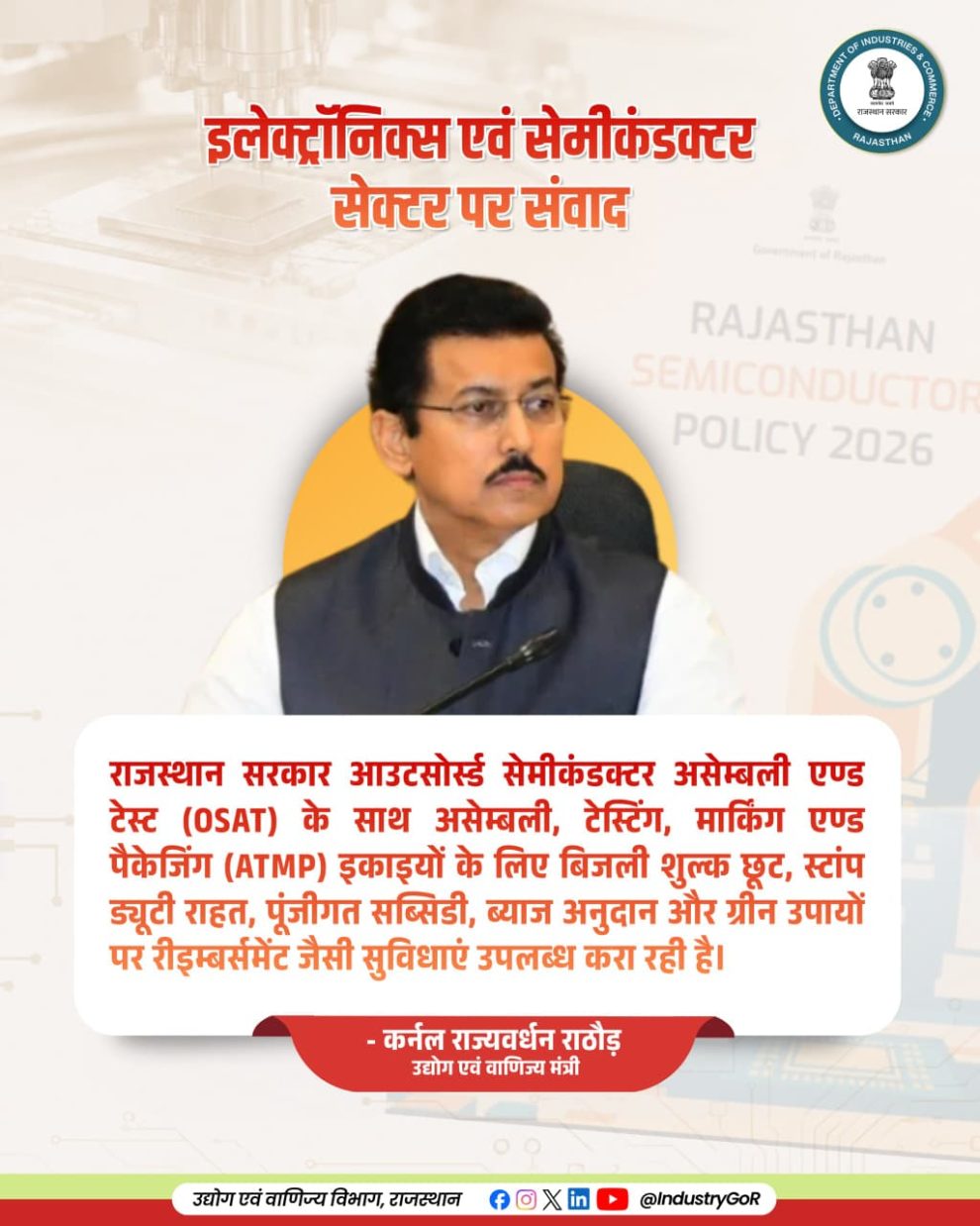
Leading this economic shift is Col. Rajyavardhan Singh Rathore, Rajasthan’s Industries, Commerce, and Information Technology Minister.
For the common man, technical acronyms like OSAT and ATMP can sound like a complex language meant only for scientists. But Col. Rathore is betting heavily on these specific technologies because they represent a practical gateway to high-paying jobs, economic security, and self-reliance for Rajasthan’s youth.
Let’s break down exactly what these terms mean in simple language and explore how this microchip revolution will transform the state’s economic landscape.
1. Decoding OSAT and ATMP: The Core Foundations Explained
To understand why this is a massive win for the state, we first need to understand what happens in a semiconductor assembly plant.
Manufacturing a microchip happens in two distinct halves. The first half is “Front-End Fabrication” (building the raw chip on silicon wafers), which requires multi-billion-dollar factories. The second, equally critical half is “Back-End Manufacturing”, which is where OSAT and ATMP come in.
- ATMP (Assembly, Testing, Marking, and Packaging): Think of a raw, newly fabricated microchip like a bare lightbulb filament—it is incredibly fragile and cannot be used on its own. ATMP is the industrial process of encasing that fragile silicon slice into a protective protective shell (Assembly), verifying that it works perfectly under extreme heat and pressure (Testing), stamping it with a tracking code (Marking), and sealing it so it can be safely soldered onto a circuit board (Packaging).
- OSAT (Outsourced Semiconductor Assembly and Test): OSAT facilities are specialized, third-party factories that perform the ATMP process at a massive commercial scale for tech companies worldwide.
By inaugurating India’s very first SME-led semiconductor ATMP/OSAT facility (Sahasra Semiconductors) inside the modern Electronics Manufacturing Cluster (EMC) in Bhiwadi, Col. Rathore has successfully positioned Rajasthan at the forefront of the national chip value chain. The plant is already packaging memory chips, LED driver ICs, and advanced eSIM solutions—with over 60% of its initial production heading directly to international export markets like the United States, France, and Germany.
2. The New Industrial Policy 2026: Removing Bureaucratic Obstacles
Major tech corporations and global investors don’t just look for empty land; they look for a clear, supportive regulatory environment free from administrative delays.
Drawing from his disciplined background as a retired Indian Army Colonel and an Olympic silver medal 2004 winner, Col. Rathore addresses governance with precise execution. He recognizes that to compete with global tech hubs, Rajasthan must eliminate old, slow bureaucratic processes.
This vision is the driving force behind the state’s newly approved Industrial Development Policy 2026. Under his leadership, the policy introduces major structural reforms designed to assist high-tech investors:
- The Deemed Approval Mechanism: If a tech investor applies for a standard layout clearance, departments must respond within a strict timeline. If they miss the deadline, the project is auto-approved by the system.
- Self-Certification & Auto-Renewals: Instead of forcing entrepreneurs to visit government offices every year for basic license renewals, the state has transitioned to an automated digital portal, reducing administrative friction.
- Targeted Capital Rebates: The policy provides specialized fiscal incentives, land rebates, and power subsidies custom-tailored for semiconductor packaging facilities and Global Capability Centres (GCCs).
3. Merging High-Tech Infrastructure with the ‘Viksit Jhotwara’ Vision
While driving macro-level economic policies as India’s prominent Industry Minister Rajasthan, Col. Rathore ensures that these high-tech advancements connect back to his local constituency work.
Through his signature Jhotwara MLA work and his broader Viksit Jhotwara development roadmap, he is actively linking tech growth to grassroots community welfare.
- Upgrading Local Education: To ensure local youth are prepared for these upcoming high-tech roles, Col. Rathore’s team is modernizing 14 local government schools with a budget of ₹3.25 crores, adding smart classrooms and digital ICT computer labs.
- Creating Regional Jobs: By establishing major industrial zones nearby, local students from Jhotwara won’t have to migrate to distant cities like Bengaluru or Pune for technical roles. High-value engineering careers are being built closer to home.
4. Digital Governance: Tech Made Easy for Citizens
As the state’s forward-thinking Rajasthan IT minister 2026, Col. Rathore believes that if the state is packaging advanced chips for the world, its own internal governance should reflect that same high-tech efficiency.
Under the state’s comprehensive Rajasthan AI policy framework, his department is systematically introducing digital tools to make life easier for ordinary citizens. For example, during his recent Jan-Samvad model public review meetings, he highlighted how the state has updated its pension rules—allowing senior citizens and specially-abled individuals to submit life certificates instantly via secure facial recognition on a smartphone app.
Whether he is introducing next-generation automation at the DigiFest Jaipur 2026 platform or driving major trade reforms as an influential government minister rajasthan, his primary objective remains exactly the same: implementing structured planning, clear timelines, and modern efficiency.
The Takeaway
The global semiconductor race isn’t just an abstract topic for tech journals; it is a vital economic pillar for the future. By securing India’s first SME-led ATMP/OSAT facility and backing it with the streamlined Industrial Policy 2026, Col. Rajyavardhan Singh Rathore is transforming Rajasthan from a traditional economic state into a modern, self-reliant technology hub. This technical focus ensures that the next generation of youth will have the tools, skills, and local opportunities to succeed in a digital world!


Add Comment